Remit Choice is authorised by the FCA in the UK and regulated by the Bank of Lithuania in the EU.
December is close, and many of us are already counting the days until we fly home. Maybe it is a wedding, a family gathering or simply a long-awaited visit to parents. Either way, a little planning now can save you stress, fees and surprises.
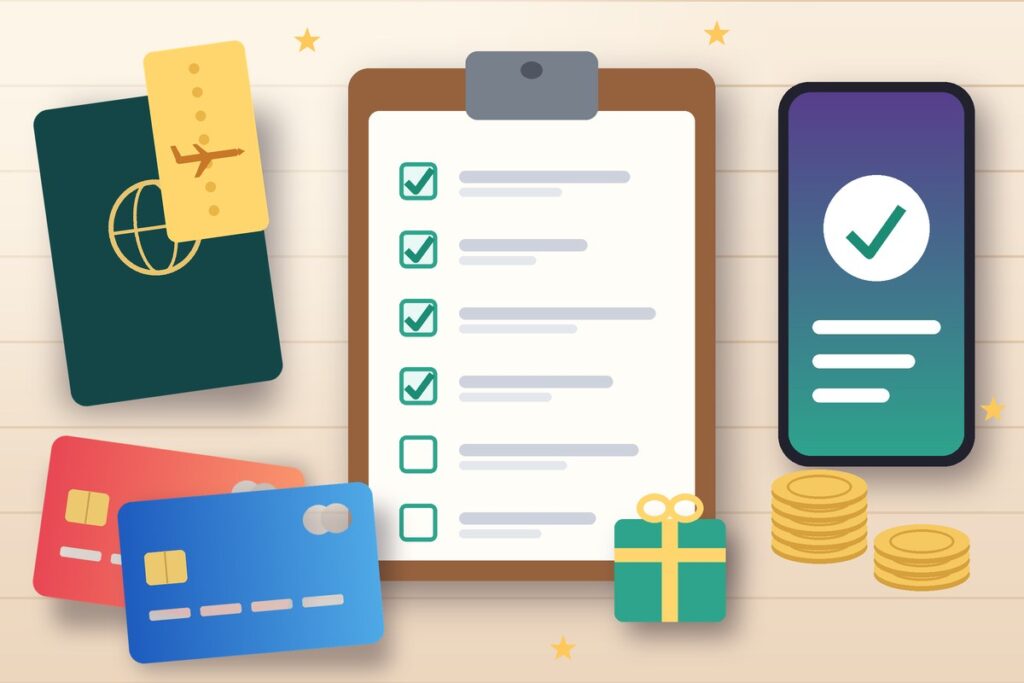
This financial checklist before you travel is written for people living in the UK, Europe, Canada, Australia or New Zealand. It covers your cards, cash, insurance, scams and the family members who rely on you. Work through it in the weeks before your flight, and tick each item off as you go.
Why a financial checklist before you travel matters
Going home feels familiar, so it is easy to skip the preparation. But your money life is now split across two countries. Your bank, your card and your phone number all belong to the country where you live. Your spending, gifts and family support happen somewhere else.
That gap is where problems start. A blocked card, a lost phone or too much cash at the airport can spoil a happy trip. Official travel guidance says the same thing. The UK government’s foreign travel checklist (from the FCDO) says to make sure you can access enough money for unexpected costs. It also suggests a backup in case your main payment method fails.
1. Get your bank and cards ready
Tell your bank you are travelling
Banks watch for unusual activity. A sudden payment in another country can look like fraud. Global Affairs Canada advises telling your bank and credit card company about your travel plans ahead of time. That way, your card is less likely to be frozen. The UK Financial Conduct Authority (FCA) also lists “tell your bank when you travel overseas” among its tips against card fraud.
Check your banking app, or call your bank, to see how it prefers to be told.
Update your contact details
If your bank needs to check a payment, it will call or text you. Make sure your mobile number and email address are up to date. Save your bank’s lost-card number somewhere other than your phone.
Carry more than one way to pay
Do not rely on a single card. Global Affairs Canada recommends bringing a mix of payment options, such as a credit card and some local cash. Keep cards in different places, so one lost wallet does not leave you stuck.
2. Understand card fees and exchange rates
Every time you pay in a foreign currency, someone converts the money. Knowing who does it, and at what rate, can save you money.
Choose the local currency
Card machines and cash machines abroad may offer to charge you in your home currency. This is called dynamic currency conversion (DCC). HSBC UK explains that DCC usually costs you more. It says to stick to the local currency if you want to avoid higher charges.
Visa says merchants must show you the amount in both currencies, the exchange rate and any extra fees. They must also let you choose and must not decide for you. If you feel pressured, Visa recommends declining the conversion.
Check your own card’s charges
Your bank may charge a fee for spending or withdrawing cash abroad. Fees differ widely between accounts. Read your account terms, or ask your bank, before you go.
Watch the exchange rate
Exchange rates move every day. Keep an eye on the rate in the weeks before your trip. That helps you plan how much to spend, and spot a poor deal at the airport counter.
3. Know the rules for carrying cash
Many families still prefer cash gifts. That is fine, but large amounts come with legal rules. These limits are about declaring cash, not banning it.
- Great Britain: according to GOV.UK, you must declare cash of £10,000 or more if you carry it between Great Britain and a country outside the UK. Families or groups travelling with £10,000 or more in total must also declare.
- European Union: the European Commission says travellers entering or leaving the EU with €10,000 or more in cash, or the equivalent, must complete a cash declaration.
- Pakistan: under Pakistan’s Baggage Rules, as amended by FBR notification SRO 2201(I)/2022, arriving passengers must declare foreign currency over US$10,000. Adults leaving Pakistan may take out up to US$5,000 per visit and US$30,000 a year. Departing passengers must declare foreign currency they carry.
Rules can change, so check the official customs website for every country on your route. Carrying less cash is often the simpler and safer choice.
4. Sort out travel insurance and health cover
Many migrants skip travel insurance when visiting home. After all, you know the country well. But medical bills can be huge, and your health cover where you live may not apply.
The FCDO’s travel insurance guidance warns that without insurance you could be liable for emergency costs. Its examples include £25,000 or more for a broken leg in Spain. It advises buying insurance as soon as possible after booking. It also says to declare existing medical conditions.
If you live in the UK and travel to Europe, a free UK Global Health Insurance Card (GHIC) can help. But the NHS says the GHIC is not a replacement for travel insurance. Apply only through the NHS website, because unofficial websites may charge a fee.
5. Protect yourself from scams
Travel brings its own scam risks, from fake deals to phishing texts and card skimmers.
- Booking deals: Global Affairs Canada warns about online deals that look too good to be true. Stick to well-known websites.
- Bank messages: the FCA says a bank will never email or text you to ask for your personal information. If in doubt, call the number on your card.
- Cash machines: use ATMs in busy, well-lit places, cover your PIN and check your statements.
Shopping before your trip? Our guide to Black Friday scams and fake discounts explains the warning signs of fake offers.
6. Plan for the family you support
If you send money home regularly, your trip can disrupt that routine. You might be offline on the day a payment is due. Or your phone might not receive bank security codes while you are abroad.
Make a simple plan
- Send any regular support before you leave, so bills and school fees are covered.
- Agree with family how they will reach you if something urgent comes up.
- Save your recipients’ details in advance, and double-check them with family directly.
- Keep a note of your money transfer provider’s official website and support contacts.
To see how much family support matters, read our look at Pakistan remittances in October 2026.
How Remit Choice can help while you are away
If you send money from the UK, Europe, Canada, Australia or New Zealand, Remit Choice is one option. Here is what our official website states:
- Payout options: depending on the country, your family can receive money by bank deposit, mobile wallet or cash pick-up.
- Tracking: you can enter a transaction number on the Remit Choice website to check the live status of a payment.
- Mobile app: the Remit Choice app includes transfer tracking, beneficiary management and rate alerts.
Set up your recipients before you fly, and your family stays covered while you are away. If you see anything suspicious, read our fraud awareness page or email [email protected].
Frequently asked questions
Do I still need to tell my bank before I travel?
Official guidance in the UK and Canada still recommends it. Ask your bank what it needs from you.
Should I pay in local currency or my home currency abroad?
Usually local currency. HSBC UK says dynamic currency conversion usually costs more.
How much cash can I carry without declaring it?
Between Great Britain and countries outside the UK, you must declare £10,000 or more. For the EU, the threshold is €10,000 or more. Check each country on your route.
Is a GHIC enough instead of travel insurance?
No. The NHS says the UK GHIC is not a replacement for travel insurance.
Can I send money home with Remit Choice while I am travelling?
Remit Choice lists sending countries including the UK, Canada, Australia, New Zealand and many European countries. Check the current list and payout options on the official website.
Sources
- GOV.UK (FCDO): Foreign travel checklist (last updated 5 June 2026)
- GOV.UK (FCDO): Foreign travel insurance
- GOV.UK: Take cash in and out of the UK
- European Commission, Taxation and Customs Union: EU cash controls
- Federal Board of Revenue, Pakistan: SRO 2201(I)/2022 amending the Baggage Rules, 2006 (12 December 2022)
- Global Affairs Canada: Protecting your money when travelling outside Canada
- Financial Conduct Authority: Banking and online account scams
- HSBC UK: Should you pay in local currency outside the UK?
- Visa: What you should know about Dynamic Currency Conversion
- NHS: Apply for a free UK Global Health Insurance Card (GHIC)
- Remit Choice: Homepage
- Remit Choice: Mobile app
- Remit Choice: FAQs
- Remit Choice: Fraud awareness